
Hidden leak signs
7 Signs of a Hidden Water Leak
Warm floors, meter movement, musty smells, stains, pressure loss, wet ground, and running-water sounds can all point to a hidden leak.

This guide is for Littleton homeowners who see the signs but not the leak itself. If your meter moves, your bill rose, a floor feels warm, or a room smells damp, read this before you open a wall or wait another month. We walk through each sign, what it can mean, what you can check today, and how a local leak specialist finds the real source.
The problem: you can feel something is wrong, but you cannot see a leak
Most hidden leaks do not start with a puddle. They start with a small change you almost ignore: a bill that creeps up, a room that smells damp, a floor that feels warm in one spot. In Littleton homes we visit, the leak is often running behind a wall, under a slab, or in a yard line while the house still looks dry. That is why the signs matter more than the stain. One sign can have a simple cause. Two or three signs at the same time almost always mean water is going somewhere it should not.
Signs 1 to 3: the meter, the bill, and the sound
Sign one is a water meter that moves when every tap, toilet, washer, and sprinkler is off. Sign two is a water bill that jumps with no new guests, no extra laundry, and no new watering. Sign three is a hissing or running-water sound in a quiet house when nothing is turned on. These three signs point to a pressurized line that keeps leaking day and night, not a one-time spill. Write down what you notice. The pattern helps us pick the first test instead of guessing.
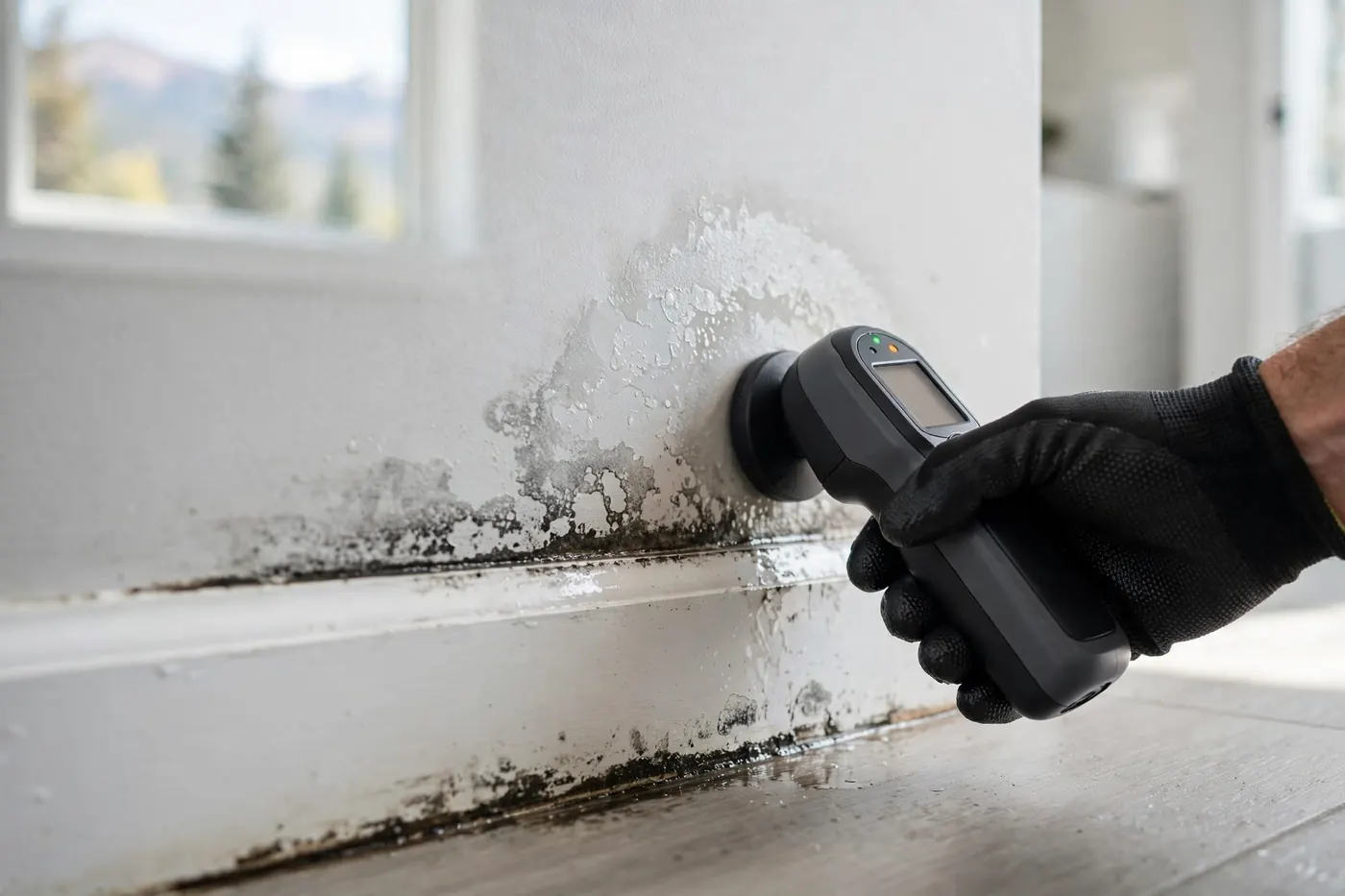

Signs 4 to 7: stains, smells, pressure, and wet ground
Sign four is a wall or ceiling stain that comes back after it dries or after you paint it. Sign five is a musty smell in one room, cabinet, or closet that does not go away. Sign six is low water pressure at more than one tap or shower. Sign seven is soft or wet ground in the yard on a dry day, or one strip of grass that stays much greener than the rest. Each sign points to a different place: a wall line, a slab line, a drain, or a buried line outside.
Littleton leak help
Noticing these signs in your home?Guessing at the source wastes time. Call our Littleton team, tell us the first sign you noticed, and we will help you choose the right test to find the hidden leak.
Safe checks you can do today, in about 15 minutes
Turn off every known water use inside and outside, then look at the meter. If it still moves, take a photo of the reading, wait 30 minutes without using water, and look again. Walk the house and feel floors for warm or soft spots. Look under sinks and behind the washer for damp wood. Step outside and look for wet soil on a dry day. These simple checks cost nothing, they do not damage your home, and they give a leak specialist in Littleton a clear place to start.
Why waiting makes a small leak a big repair
A hidden leak does not heal. It soaks wood, drywall, and soil a little more each day. Floors can lift, paint can bubble, mold can grow in damp walls, and a slab leak can soften the soil under concrete. Homeowners in Columbine Hills, Ken Caryl, and Old Littleton often tell us the sign was there for weeks before the damage showed. Acting on the first signs almost always keeps the repair area smaller and the total damage lower.
How we find the source without opening random walls
We start with your signs, not with a drill. We check the meter, map where moisture is highest, listen along the pipe path with acoustic tools, and use heat and pressure checks where they fit. Each test rules out one area and makes the next area clearer. At the end, you get a small marked area, a plain-words reason for it, and a clear next step for repair. That is the whole point of professional leak detection in Littleton, CO: find it first, open once.
What to do next: a simple step-by-step plan
Work through these steps in order. Each step either fixes a simple cause or gives you strong proof that a hidden leak needs professional testing. Stop at the step where the cause turns clear, and do not jump ahead to opening walls or floors.
- Write down every sign you have and when it started. One clear list stops guesswork and helps us match the pattern to the right system on the first visit.
- Do the meter test. Turn off all taps, toilets, appliances, and sprinklers, look at the meter, wait 30 minutes without using water, then look again. If it moved, water is leaving the system somewhere hidden.
- Feel and look, do not cut. Feel floors for warm or soft spots, look under sinks, and check the yard for wet soil on a dry day. Take photos so you can show what changed.
- Stop using the area that makes it worse. If a shower, washer, or sprinkler zone makes the sign stronger, leave that system off until it is checked.
- Call a Littleton leak specialist while the signs are fresh. Early testing usually means a smaller marked area and less damage to floors, walls, and soil.
Mistakes that turn a small leak into big damage
In many Littleton homes, the worst damage does not come from the leak itself. It comes from a quick fix tried before the true source was known. Avoid these three mistakes:
- Painting over a stain and hoping it stays dry. Paint hides the clue, not the leak, and the stain almost always returns bigger.
- Opening the wall or floor where the sign looks worst. Water travels along pipes and wood, so the wettest spot is often not the source.
- Waiting for a puddle. By the time water shows on the surface, it may have soaked hidden materials for weeks.
Why we see these signs a lot in Littleton homes
Littleton has a mix of older homes in Historic Downtown and Old Littleton, slab homes in Ken Caryl and Columbine Hills, and newer builds in Trailmark and Sterling Ranch. Older homes can hide leaks in aging supply lines. Slab homes can hide them under concrete with only a warm floor as a clue. In summer, irrigation lines in Grant Ranch and Highlands Ranch add one more hidden path for water. That mix is why we never blame one system from one sign. We test the pattern, area by area, until the evidence agrees.
The point where a specialist should take a look
Call Littleton Leak Solutions at (720) 715-9731 if any sign repeats for more than a few days, if the meter moves with all water off, if a stain keeps coming back, or if you hear water when the house is quiet. If water is spreading now, a ceiling is sagging, or you smell gas, treat it as urgent first: stay clear of wet electrical areas, use the shutoff only if it is safe, and call right away.
Littleton leak help
Noticing these signs in your home?Guessing at the source wastes time. Call our Littleton team, tell us the first sign you noticed, and we will help you choose the right test to find the hidden leak.
What a good result looks like
You should end with a smaller search area, the evidence explained in plain words, and one clear next step. You should know which system is leaking, where the strongest evidence points, and which single area the repair team needs to open. If a test has limits, those limits should be shared in simple words before any repair begins. That is what our team at Littleton Leak Solutions, based at 2260 W Chenango Ave #400 and serving all 21 Littleton-area communities since 2018, works to give every caller.
One repeating sign is enough to call, and two or more signs together make a hidden leak much more likely. A moving meter plus a warm floor, or a stain plus a musty smell, should not be watched for weeks.
Yes. That is very common. Water can run under a slab, inside a wall, or into soil for a long time before it ever shows on a surface you can see.
No. Poor air flow can cause a smell too. But a musty smell in just one room, cabinet, or wall area, that stays after cleaning and drying, is a strong leak clue and should be checked.
Tell us which signs you have, when each one started, which room or yard area it is in, and whether the meter moves with all water off. Those four facts decide which test comes first.
A meter that moves with every fixture off. It means water is leaving the system right now, even if nothing looks wet yet.
It happens. A running toilet and a slab leak can exist in the same home. We isolate systems one at a time so one problem does not hide the other.
Weeks to months, depending on the rate. Floors, drywall, and soil usually suffer quietly before the first visible sign appears on a surface.
Yes, if the smell stays in one room or cabinet after cleaning and drying. A smell map is a real starting clue for moisture testing.
Do these signs match your home?
Call our local Littleton specialists at (720) 715-9731 and tell us which sign you spotted first.
Call (720) 715-9731